
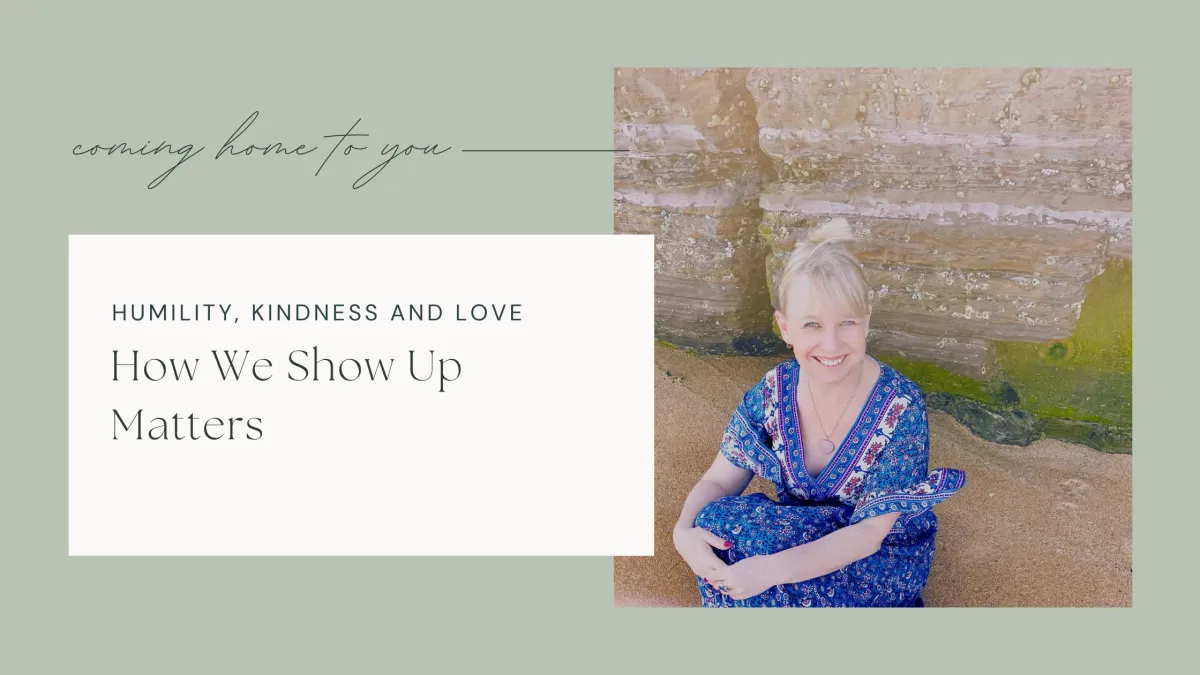
How We Show Up Matters
An Unexpected Invitation
Last weekend I attended a Humility, Kindness and Love conference in Sydney.
It wasn’t something I had been seeking out. The invitation was random, and I had no real sense of what I was walking into. But the name alone made me pause. Humility. Kindness. Love. It didn’t feel like something that could be a bad thing.
So I went. Without expectation, without agenda, simply open.
In hindsight, that openness feels significant. I’m noticing more and more how the most meaningful moments in life don’t arrive through striving or certainty, but through willingness. Through saying yes without needing to know exactly why.
What unfolded over the day wasn’t about learning something new as much as remembering something essential. It became a gentle invitation to slow down, to listen more deeply, and to reflect on where humility, kindness, and love truly sit in our lives - not as ideals to aspire to, but as ways of being.
Purpose has layers. There is the collective mission we are all part of, and there is our individual assignment within it. But at the centre of it all, beneath the doing, the roles, and the expressions, is something more fundamental.
The quality of presence we bring, and how we show up moment to moment.
Long before purpose becomes something we do, it is something we are.
The World’s Narrative and a Deeper Way of Living
One of the moments that stayed with me from the day was a story shared by Baba Ji, the founder of the Humility, Kindness and Love movement.
He spoke about a headline he had read in his morning paper that declared we must be “ruthlessly selfish” to survive in today’s world. He reflected on this not as wisdom, but as a sickness, a sign of how far we have drifted from what truly sustains us.
That distinction matters. There is a difference between protecting our peace and becoming self-centred. Between holding healthy boundaries and closing our hearts. Yet in many environments, particularly those shaped by competition and achievement, these lines have become blurred.
I was reminded of a team-building exercise I participated in several years ago. We were asked to share our core values as a way of getting to know one another. As the words were written up on the board - ambition, success, growth, achievement - I remember feeling genuinely surprised that I was the only person in the room who named love and kindness.
Not because the room wasn’t full of good people. It was. But because the culture we were operating within didn’t reward those values. It rewarded striving, output, and results.
Over time, we absorb these messages. We learn, often unconsciously, that humility is weakness, kindness is inefficiency, and love is something best kept private or personal. And so we harden. We perform. We strive. Even in our search for purpose.
Yet something in me has always resisted that story. And sitting in that conference, hearing the words humility, kindness, and love spoken so plainly, I was reminded that there is a deeper way of living available to us - one that doesn’t require us to abandon ambition or boundaries, but asks us to anchor them in something truer.
Simplicity, Presence, and Truth
Throughout the day, the theme of simplicity surfaced numerous times.
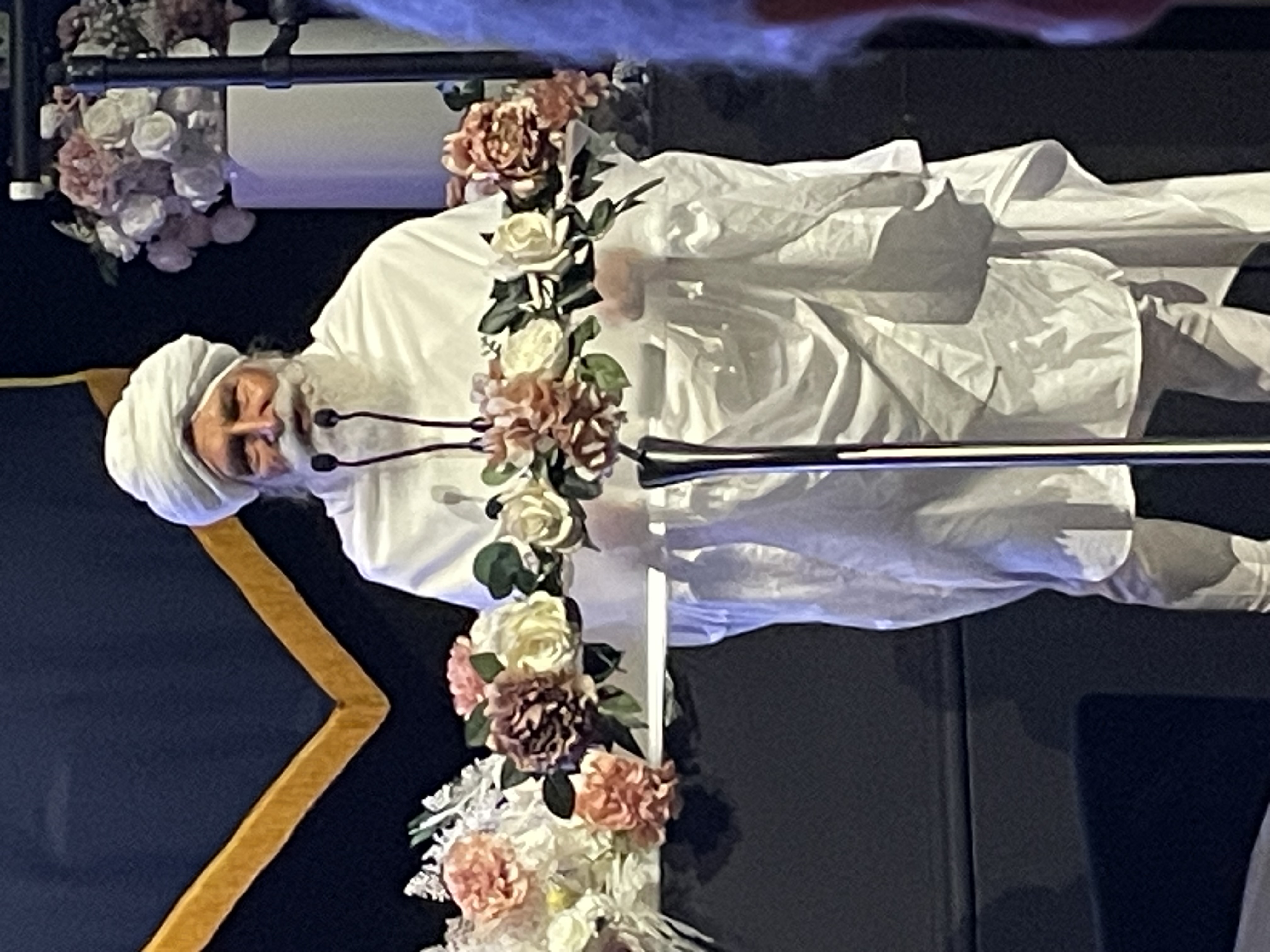
At one point, Baba Ji shared a reflection that stayed with me. He said, “Truth is simple. God is simple. Everything else is complex.”
It wasn’t said as a teaching to analyse, but as something to recognise.
In a world that often equates complexity with intelligence and busyness with importance, simplicity can feel almost confronting. Yet there is a quiet clarity in it. When something is true, it doesn’t need to be defended or embellished. It has a way of standing on its own.
As I listened, I began to notice how often we overcomplicate what is essential, including our understanding of purpose, spirituality, and even love. We add layers of explanation, effort, and performance, when what is being asked of us is far simpler.
Simplicity, as it was spoken about that day, was not about doing less for the sake of it. It was about presence. About being fully here. About meeting the moment without distraction or agenda.
And in that simplicity, something deeper becomes available. A way of being that doesn’t rely on force or striving, but on attentiveness, humility, and quiet trust.
The Power of Being Truly Seen
One of the most moving moments of the day came through an interaction that was, on the surface, very simple.
A First Nations woman took the stage to speak about heart and Country. Before she began, Baba Ji greeted her. He looked at her with full heart and attention, paused, and asked her three simple words: How are you?
But this was not the way we so often ask that question - as a greeting, a reflex, a passing exchange. There was no rush in it. No distraction. No sense of needing to move on to the next thing.

In that moment, she was moved to tears.
Not because of who he was in the room, or the reverence surrounding him, but because she felt truly seen. Perhaps in a way she hadn’t felt for a very long time.
It struck me in that exchange how much impact can be created through something so small. No grand gesture. No profound teaching. Just presence - grounded in humility, kindness, and love.
It reminded me how rarely we offer one another this kind of attention. How often our bodies are present while our minds are elsewhere. How easily we miss the opportunity to meet someone where they actually are.
And yet, it is often in these simplest moments, when we slow down enough to be fully with another, that something sacred is felt. Something settles. Something heals.
When Words Are Not Matched by Presence
As the day unfolded, there was a noticeable contrast between moments that felt deeply grounded and others that felt strangely hollow.
Several public figures and politicians took the stage to speak about kindness, love, and coming together. Much of what they referenced was timely and important, drawing on recent tragic events and the ways communities had responded in their aftermath. The words themselves were not wrong.
And yet, something felt off.
As other speakers shared, I noticed some of these same figures sitting on the stage, distracted, on their phones, disengaged from what was being said around them. The dissonance was striking - speaking about humility and love, while simultaneously demonstrating a lack of presence and respect.
It wasn’t anger that arose in me, but a deeper clarity.
There is a difference between talking about kindness and embodying it. Between advocating for love and being present enough to listen. Presence, I’m realising, is one of the truest measures of humility. It reveals where our attention, and our reverence, actually sits.
Later in the day, a Buddhist monk offered a reflection that helped bring language to this distinction. He spoke about the importance of both the head and the heart working together - knowledge and wisdom in harmony.
Knowledge lives in the mind. Wisdom lives in the heart.
When the head leads without the heart, we may sound convincing, but something essential is missing. Wisdom requires discernment - the ability to see clearly without hardening, to remain compassionate without becoming naïve.
This feels especially important in the current times.
Discernment in the Times We Are Living In
As I sat with these reflections in the days that followed, the importance of discernment kept returning.
We are living in a time where discernment is more necessary than ever. Where information moves faster than wisdom, and where narratives are often shaped to provoke reaction rather than understanding. We are seeing the depths of deception come to the surface, agendas that divide rather than unite, and atrocities spoken about with a casualness that should stop us in our tracks.
In moments like this, it can be tempting to harden. To pick sides quickly. To retreat behind certainty or outrage. It can also be tempting to turn away. To numb ourselves. To disassociate, distract, or convince ourselves that what is unfolding has nothing to do with us.
But discernment asks something more demanding of us.
Discernment requires humility, the willingness to admit that we do not see the full picture. It requires kindness, the capacity to remain human with one another even when we disagree. And it requires love, not as sentiment or passivity, but as a steady commitment to truth, dignity, and our shared humanity.
I believe we are being asked, collectively, to choose a different posture. Not one of division or force, but one of responsibility. Responsibility for how quickly we react. Responsibility for what we amplify. Responsibility for whether we allow ourselves to be pulled into fear, outrage, or certainty without first pausing to reflect.
It asks us to slow down our reactions. To listen more deeply. To meet one another with a spirit of generosity, even when we disagree.
This responsibility is not about blame or superiority. It is about waking up, gently but honestly, to how easily we can be shaped by what we consume, and how much influence we carry simply through how we show up.
In this way, humility, kindness, and love are not naïve responses to the world as it is. They are necessary ones.
The Quiet Power of Humility, Kindness, and Love
There is a framework that has helped me understand why these qualities matter so deeply, particularly in times like these.
In Power vs Force, psychiatrist and consciousness researcher David R. Hawkins offers a perspective that reframes how change actually happens in the world. He suggests that consciousness does not operate on a linear scale, where one person simply equals one unit of influence. Instead, some states of consciousness carry a disproportionate amount of impact. Higher states of consciousness carry exponentially more impact than lower ones.
What this means is quietly profound.
A small number of people living from humility, kindness, love, and inner alignment can counterbalance vast amounts of fear, anger, and reactivity in the collective. Not through effort. Not through argument. Not through force. But through presence.
In this framework, love is not sentimental or passive. It is stabilising. It brings coherence. It restores order simply by being embodied. The same is true of humility and kindness. They do not demand attention, yet their influence ripples far beyond what is visible.
Hawkins’ work suggests that large numbers of people operating from fear-based states can be outweighed by a relatively small number of people living consistently from love or higher levels of consciousness. In other words, the quality of consciousness outweighs the quantity of people.
From this perspective, humility takes on a deeper meaning. It is not about shrinking or self-erasure. It is about being so anchored in truth that there is no need to dominate, convince, or perform.
Kindness, then, is not weakness. It is strength without force.
And love is not merely an emotion. It is a state of alignment that quietly serves the whole.
Seen this way, inner work is not self-indulgent. Choosing integrity over reaction, compassion over judgement, and presence over performance is not just personal growth, it is collective service.
Humility, kindness, and love do not ask us to disengage from the world as it is. They ask us to engage without losing ourselves. To stand for truth without becoming hardened. To respond with clarity rather than reactivity.
You don’t have to be loud to be powerful. But you do have to be awake.
Sometimes, the most meaningful contribution you can make is to remain steady, kind, and anchored in truth, even while confronting what is false, distorted, or harmful.
Anchoring Light Through How We Live
If there is a thread that runs through humility, kindness, love, discernment, and wisdom, it is this: how we show up matters.
Purpose has layers.
There is the collective layer - the shared responsibility we carry to tend to this world and one another with care.
There is the individual layer - the unique assignment each of us carries, shaped by our gifts, experiences, and callings.
And beneath both of these sits the core layer - the one we cannot bypass.
Before purpose becomes something we do, it is something we are.
Before action, there is presence.
Before contribution, there is orientation of the heart.
This is the layer that expresses itself moment by moment. Through how we listen, how we speak, how we respond under pressure, and how we remain anchored when the world pulls us toward reactivity.
This is where humility quietly restores right relationship - with ourselves, with God, with life, and with one another. Not as an idea, but as an embodied posture.
Kindness becomes the way we move through the world without adding to its weight.
Love becomes the steady current that guides action without needing force or performance.
This inner orientation shapes everything else. It shapes how we know ourselves. It shapes how we grow. It shapes what we sow.
In this way, humility, kindness, and love are not optional virtues added on to purpose once we “figure it out.” They are the current that carries purpose forward at every stage.
From this place, the outer layers of purpose naturally organise themselves. What we are here to do begins to emerge from how we are here to be.
This is also where our individual assignment meets the collective one.
We may each have a unique role to play, but the way we anchor light into the world happens through the same simple, demanding practice - choosing presence, truth, and love in the moments that matter and the ones that seem to pass unnoticed.
Purpose, then, is not something we arrive at once and for all. It is something we live into layer by layer, moment by moment, through who we are willing to be.
Perhaps this is the invitation of these times.
Not to step away from purpose, but to deepen our relationship with it.
Purpose is not only found in what we are here to do, but in how we show up along the way - moment by moment, choice by choice.
When humility, kindness, and love shape this inner layer of purpose, our outer expressions gain clarity and coherence. What we are called to build, offer, or stand for begins to flow from integrity rather than effort.
So alongside asking what am I here to do?, perhaps we also ask how am I being asked to show up - today, in this moment?
Because when we live from this place, purpose does not fade.
It deepens and becomes something we embody, not just pursue.
If You’re Seeking Deeper Clarity
If these reflections resonate, and you find yourself sensing that your purpose is calling for more clarity, grounding, or alignment, The Purpose Blueprint was created for you.
It’s a guided journey to reconnect with your true self, release old conditioning, and allow your purpose to emerge from presence rather than pressure.
You can learn more about The Purpose Blueprint here.